 THE GLOWNIQUE
Can You Put a Neon Sign Outside? IP Ratings, Weatherproofing & Setup Guide
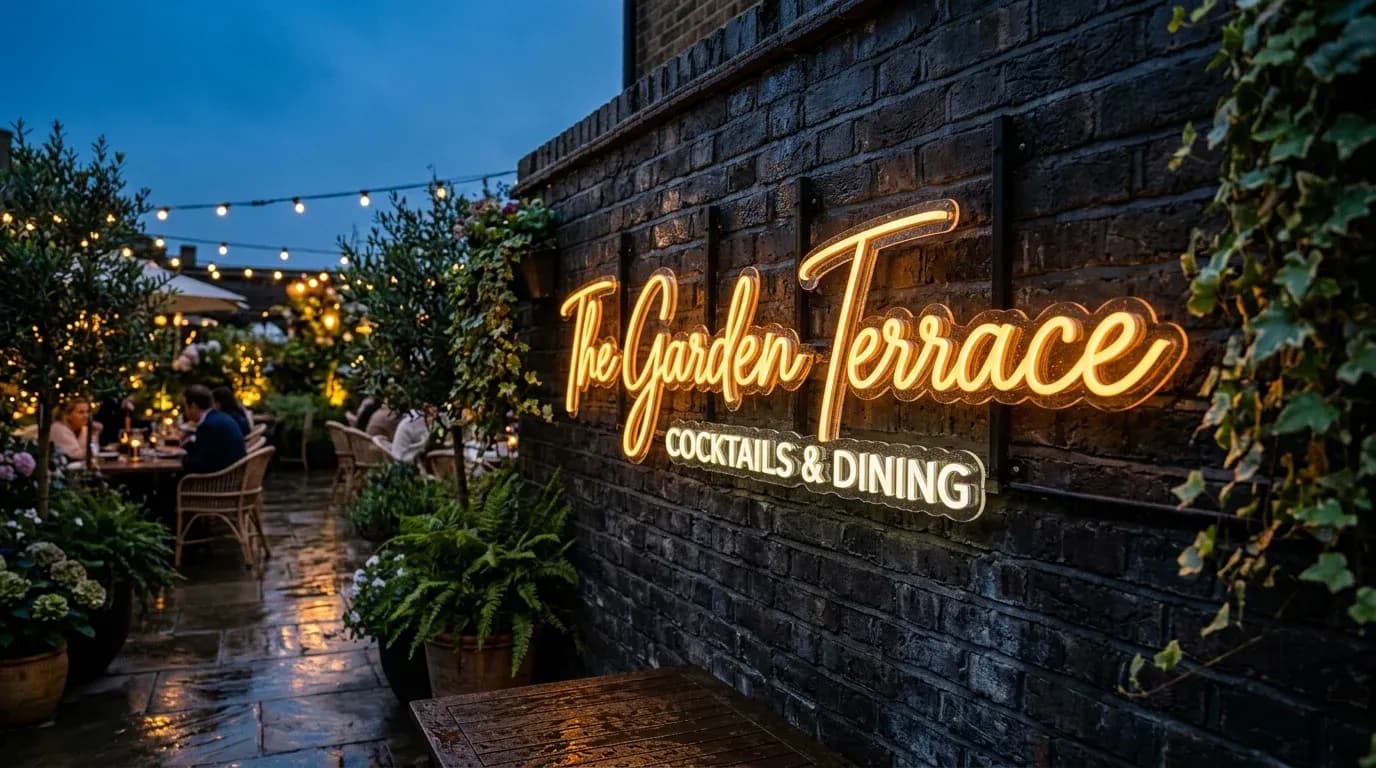
Yes, you can put an LED neon sign outside, but only if it is explicitly engineered with an IP65 or IP67 weatherproof build. Standard indoor neon signs will quickly corrode and fail if exposed to rain, humidity, or sunlight. A true outdoor build features sealed silicone flex, waterproof solder connections, a weatherproof IP67 power driver, and a GFCI-protected exterior circuit.
Key takeaways
- Standard indoor LED neon signs lack moisture barriers and will rapidly short-circuit, corrode copper solder joints, and yellow under UV sunlight if installed outdoors.
- For covered outdoor environments like porches, awnings, and sheltered garden patios, an IP65 rating provides reliable protection against airborne humidity, splashback, and light moisture.
- For direct exposure to driving rain, snow, or high-humidity coastal air, a full IP67 build with waterproof dielectric silicone injection potting is strictly necessary.
- The primary failure point of outdoor illuminated signs is the power supply: never place an indoor transformer outdoors, and always use an IP67 aluminum driver with a cable drip loop.
- Exterior mounting requires UV-stabilized cast acrylic backing with stainless steel standoff spacers to prevent moisture entrapment between the sign and the masonry wall.
The short answer is yes, you can safely put an LED neon sign outside—provided it is specifically engineered with an IP65 or IP67 weatherproof build. Standard indoor neon signs cannot survive exterior exposure: ambient moisture, rain, high humidity, and ultraviolet sunlight will quickly corrode copper solder pads, fog the optical jacket, and cause electrical failure within weeks.
However, a purpose-built outdoor LED neon sign is engineered to withstand heavy rainstorms, sub-zero winter temperatures, and summer heatwaves. Whether you are styling an open-air restaurant patio, mounting a storefront logo, or installing illuminated wedding signage on an exterior garden terrace, understanding how outdoor weatherproofing works is essential before specifying your build. This comprehensive engineering guide explains the difference between indoor and outdoor construction, decodes IP65 versus IP67 ingress protection standards, details outdoor power driver wiring, and provides a workshop checklist for lasting exterior performance.
The fundamental difference: indoor vs outdoor LED neon construction
At a glance from across the street, an indoor sign and an outdoor sign may look similar when illuminated. Under the microscope in our workshop, however, their fabrication methods are entirely distinct.
Standard indoor signs prioritize maximum flexibility and lightweight aesthetic minimalism. The flexible silicone or PVC jacket is cut cleanly, wired with miniature exposed solder connections, and affixed to standard interior-grade cast acrylic. Because indoor environments are climate-controlled and dry, these joints do not require hermetic liquid barriers.
An outdoor LED neon sign, by contrast, is engineered as a sealed environmental enclosure. Every single linear meter of tubing, electrical splice, backboard perforation, and mounting standoff is fabricated to resist three destructive exterior forces: moisture ingress, ultraviolet degradation, and thermal contraction.
Decoding IP ratings: why IP65 and IP67 are not the same
When researching outdoor neon signs, you will frequently encounter two-digit Ingress Protection (IP) ratings established by the International Electrotechnical Commission under standard IEC 60529. The first digit measures protection against solid particles like dust (scale 0 to 6), while the second digit measures protection against liquids (scale 0 to 9).
Understanding these ratings prevents costly specification errors:
| Ingress rating | Particle protection | Liquid protection level | Recommended exterior application |
|---|---|---|---|
| IP20 (Indoor) | Touch proof (>12.5 mm) | Zero liquid protection | Strictly indoor bedrooms, living rooms, and dry retail walls |
| IP65 (Splash-resistant) | Complete dust-tight barrier | Protected against low-pressure water jets from any direction | Covered porches, semi-enclosed patios, recessed entryways, under awnings |
| IP67 (Submersible / Rain-proof) | Complete dust-tight barrier | Protected against continuous heavy rain and immersion up to 1 meter | Uncovered exterior facades, open garden patios, rooflines, outdoor event venues |
| IP68 (Continuous submersion) | Complete dust-tight barrier | Protected against permanent underwater submersion under pressure | Submerged architectural water features and swimming pool lighting |
For true outdoor installations with no overhead roof protection, specifying IP67 is mandatory. While an IP65 sign easily survives blowing dust and light airborne spray under a patio canopy, direct driving rain running down a building facade will eventually penetrate standard IP65 capillary seams.
Anatomy of an outdoor sign: four critical engineering requirements
Fabricating an LED neon sign that survives multiple seasons of extreme outdoor weather requires four specialized structural safeguards:
- UV-stabilized optical silicone flex: Budget signs use polyvinyl chloride (PVC) tubing that contains volatile plasticizers. When exposed to solar ultraviolet radiation, PVC oxidizes, turns brittle, and develops an unsightly brownish-yellow tint within months. High-grade outdoor signs utilize 100% optical silicone extrusion, which remains chemically inert and optically crystal-clear under direct UV exposure.
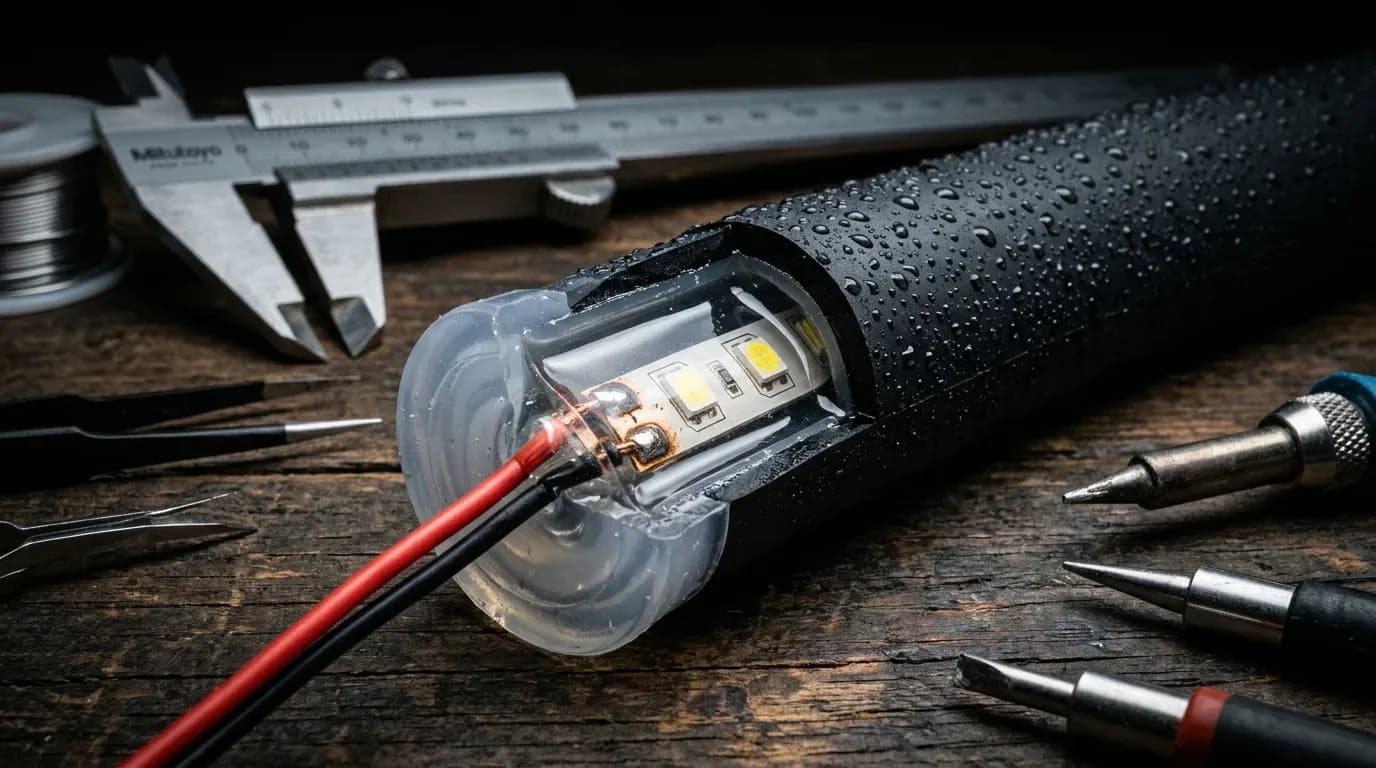
- Dielectric silicone potting at all cut ends: Every time neon flex is cut to shape a letter or contour, internal copper circuit traces are exposed. In an outdoor build, our workshop seals each end-cut with molded silicone end-caps and injects non-conductive, dielectric potting gel that cures into a permanent, watertight barrier.
- Marine-grade 304 or 316 stainless steel standoffs: Flat-mounting a sign flush against an exterior masonry or stucco wall traps rainwater and dirt behind the acrylic backboard. Outdoor signs should always be installed using 1-inch stainless steel standoff spacers, which allow rainwater and air to flow freely behind the sign.
- UV-resistant cast acrylic backboard with drainage channels: Standard extruded acrylic can warp or craze when subjected to outdoor temperature swings. Premium outdoor signs use 6mm to 8mm heavy-duty cast acrylic treated with UV stabilizers to eliminate discoloration and structural warping over years of solar exposure.
The power supply: the primary failure point in outdoor neon
When outdoor illuminated signs stop working, inexperienced buyers often assume the LED flex has failed. In over 90% of field diagnoses, the real culprit is an improper power supply installation.
Standard 12V power supply bricks included with consumer electronics are vented plastic enclosures meant solely for dry indoor wall outlets. If plugged in on an open patio or exposed wall, morning dew or rainfall will enter the internal switching circuitry, tripping the breaker and destroying the transformer.
To ensure long-term exterior reliability, your electrical setup must incorporate three safety elements:
- Aluminum-housed IP67 exterior power driver: Your sign must be powered by an encapsulated exterior LED driver (such as an IP67-rated Mean Well power unit) sealed in a rugged aluminum heat sink with watertight rubber cable glands.
- The cable drip loop: Water naturally travels downward along wires following gravity. Whenever routing power cabling toward an exterior junction box, outlet, or wall penetration, always form a downward U-shaped loop in the wire below the entry point. Any rain dripping down the cord will collect at the lowest curve and drop off safely, preventing moisture from entering the electrical terminals.
- GFCI-protected exterior receptacle: All outdoor sign connections must plug into a Ground Fault Circuit Interrupter (GFCI) outlet housed inside a weatherproof in-use cover (commonly called a bubble cover), in strict compliance with National Electrical Code (NEC Article 600).
Temperature extremes: how winter freeze and summer heat affect LED neon
Prospective buyers often ask whether outdoor neon signs can survive harsh freezing winters or sweltering summer afternoons. Here is how modern solid-state technology performs across climatic extremes:
- Sub-zero winter performance (-20°C to 0°C / -4°F to 32°F): Modern solid-state LEDs perform exceptionally well in cold weather. Because LEDs are semiconductor diodes, low ambient temperatures actually increase their electrical efficiency and prolong diode lifespan. Unlike vintage glass neon—which relies on gas vapor that dims, flickers, and struggles to strike in sub-freezing temperatures—LED neon delivers instant, full-brightness illumination in snow and ice.
- Extreme summer heat and direct solar exposure (35°C to 50°C / 95°F to 122°F): In hot climates, solar heat gain raises the sign's internal thermal footprint. High-density silicone flex safely operates up to 60°C (140°F). However, if your sign is mounted on a south-facing dark brick wall in direct desert sunlight, pairing your sign with an inline dimmer set to 75% or 80% brightness during the hottest afternoon hours drops internal junction temperatures substantially.
Step-by-step checklist for safe outdoor installation
Before mounting your weatherproof sign on an exterior wall, review this five-point workshop checklist to avoid common installation pitfalls:
- Inspect your mounting substrate: Ensure the exterior brick, masonry, stucco, or wood siding is structurally sound and free from crumbly mortar. Use masonry drill bits and matching nylon expansion anchors for stone and brick facades.
- Mount with standoffs rather than flush screws: Always install the sign using stainless steel standoff barrels. Elevating the sign 20mm to 25mm away from the building wall prevents dirt accumulation, promotes convective heat dissipation, and allows moisture to drain away freely.
- Ensure adequate low-voltage wire length: Plan your wiring pathway so the connection cable reaches your weatherproof electrical enclosure without being pulled taut. Never stretch silicone wiring around sharp masonry edges.
- Form a mandatory drip loop: Loop every exterior power wire downward before it enters a wall grommet, conduit, or outdoor outlet box to prevent water tracking.
- Test the GFCI circuit before final securing: Power the sign on and test the dimmer remote and GFCI circuit breaker to verify that the power driver delivers clean, regulated 12V direct current.
Designing your custom outdoor illuminated sign
Adding an illuminated sign to your patio, garden pavilion, or business storefront elevates your outdoor ambiance and establishes a welcoming focal point after dark. By choosing an authentic IP67 waterproof build and pairing it with a certified exterior power driver, you can enjoy stunning, trouble-free glow through every season.
At The Glownique, all outdoor signs are handcrafted using commercial-grade optical silicone flex, UV-stabilized cast acrylic backing, and stainless steel architectural standoffs. Whether you need a bespoke family monogram for an outdoor patio or a bold commercial facade, explore our handcrafted custom LED neon signs with available exterior weatherproofing, or discover our architectural solutions for custom retail storefront business signs.
Frequently asked questions
- Can you put an LED neon sign outside in the rain?
- Yes, but only if the sign is specifically manufactured with an IP65 or IP67 weatherproof build. An IP67-rated sign features hermetically sealed silicone tubing and waterproof potting compound capable of withstanding heavy rainfall and snow. Never expose a standard indoor sign to rain.
- Can I turn my existing indoor neon sign into an outdoor sign?
- No. Attempting to spray clear coat or apply silicone sealant over an existing indoor sign rarely creates a reliable waterproof seal. Indoor signs use non-UV-stabilized PVC and unsealed solder connections that inevitably suffer moisture penetration and short-circuiting over time.
- What is the difference between IP65 and IP67 neon signs?
- An IP65 sign is splash-resistant and dust-tight, making it ideal for covered porches, outdoor dining verandas, and sheltered awnings. An IP67 sign is fully waterproof and can withstand driving rain, snowstorms, and temporary immersion, making it necessary for open-air building facades and uncovered patios.
- Do outdoor neon signs require a special power supply?
- Yes. Indoor power adapters are unsealed plastic bricks that will fail if exposed to exterior moisture. Outdoor signs require an encapsulated IP67 aluminum-cased exterior power driver connected to a GFCI-protected outdoor outlet with a weatherproof in-use cover.
- How long does a weatherproof outdoor neon sign last?
- When properly built with optical silicone flex and an IP67 power driver, an outdoor LED neon sign offers an L70 operating lifespan of 40,000 to 50,000 hours. Operating the sign 8 to 10 hours daily delivers between 10 and 15 years of reliable exterior illumination.
- Will cold winter temperatures damage an outdoor neon sign?
- No. Solid-state LEDs thrive in low temperatures down to -20°C (-4°F). Unlike traditional glass neon tubes that flicker and dim in the winter due to cold gas pressure drops, LED neon signs light up instantly at full brightness in freezing weather.
Sources
- IEC 60529: Degrees of protection provided by enclosures (IP Code) — International Electrotechnical Commission (accessed 24 October 2026)
- UL 8750: Standard for Light Emitting Diode (LED) Equipment for Use in Lighting Products — Underwriters Laboratories (accessed 24 October 2026)
- NFPA 70: National Electrical Code (NEC) Article 600 - Electric Signs and Outline Lighting — National Fire Protection Association (accessed 24 October 2026)
Turn the idea into a sign
Send us your logo, words or a rough sketch and we'll come back with a free digital mockup and a quote for your exact size — before anything is built.