 THE GLOWNIQUE
Can You Leave a Neon Sign On All the Time? Power, Safety & 24/7 Running Costs
Yes, modern 12V LED neon signs are completely safe to leave on 24/7 or overnight. They remain cool to the touch, draw only 20 to 70 watts (costing $1.00 to $3.50 a month at typical US electricity rates), and carry zero high-voltage fire risk. However, using a dimmer or smart plug extends the power adapter's lifespan significantly.

Key takeaways
- Modern LED neon signs run on 12V direct current and stay cool to the touch (typically 30°C to 38°C), making them safe to leave on continuously or overnight.
- A typical 36-inch sign draws 35 to 50 watts, costing roughly $1.40 to $2.00 per month when operated 10 hours daily, or under $3.50 per month running 24/7 at US average electric rates.
- Unlike vintage gas neon requiring 2,000V to 15,000V AC transformers, LED neon operates within Safety Extra-Low Voltage (SELV) limits with zero combustible gas or glass shatter risk.
- While continuous illumination does not damage solid-state LEDs, it steadily consumes their 50,000-hour L70 lifespan and generates thermal wear on the AC/DC power adapter.
- Pairing your sign with an inline dimmer set to 70% brightness or a simple $10 smart plug timer cuts power usage by 30% and roughly doubles the lifespan of your power driver.
The short answer is yes, you can safely leave a modern LED neon sign on all the time or overnight. Unlike vintage glass neon signs that operate on thousands of volts and generate intense heat, modern LED neon signs run on safe, low-voltage 12V direct current. They remain cool to the touch (typically between 30°C and 38°C), carry virtually zero fire hazard, and draw so little electricity that running a sign 24/7 adds only $1.20 to $3.50 per month to your electric bill.
However, leaving an LED sign continuously powered has trade-offs. While the solid-state LEDs will not blow out suddenly, continuous illumination steadily burns through their rated 50,000-hour lifespan and puts steady thermal stress on the AC/DC power adapter. This comprehensive engineering guide explains how much electricity custom neon signs actually draw, breaks down exact monthly operating costs across four sizing tiers, reviews bedroom and commercial safety, and details how simple dimming controls can double your sign's working lifespan.
How much electricity does an LED neon sign actually use?
To calculate power consumption, you must look at the total linear length of illuminated flexible tubing rather than the acrylic backboard size alone. High-density commercial LED neon flex—the standard silicone extrusion used at The Glownique—draws approximately 7 to 10 watts per meter (roughly 2.2 to 3.0 watts per linear foot).
A single-word script sign like *Glow* or *Home* uses roughly 1.5 to 2.0 meters of flex, drawing approximately 15 to 20 watts of total power. A medium wedding or photo-backdrop sign with three words across two lines typically uses 4.0 to 5.5 meters of flex, drawing roughly 35 to 50 watts. For comparison, a standard modern 65-inch television consumes between 100 and 150 watts, while a typical household refrigerator draws 300 to 500 watts. An LED neon sign draws less power than a modest desk lamp.
Real monthly running costs: 10 hours daily vs 24/7 continuous operation
To see what leaving your sign on actually costs on your utility bill, we calculated energy usage across four standard sign sizes using the latest US national commercial average electricity rate of $0.168 per kilowatt-hour (kWh) published by the US Energy Information Administration.
| Sign size & flex length | Rated wattage | Monthly cost (10 hrs/day) | Monthly cost (24/7 continuous) | Recommended application |
|---|---|---|---|---|
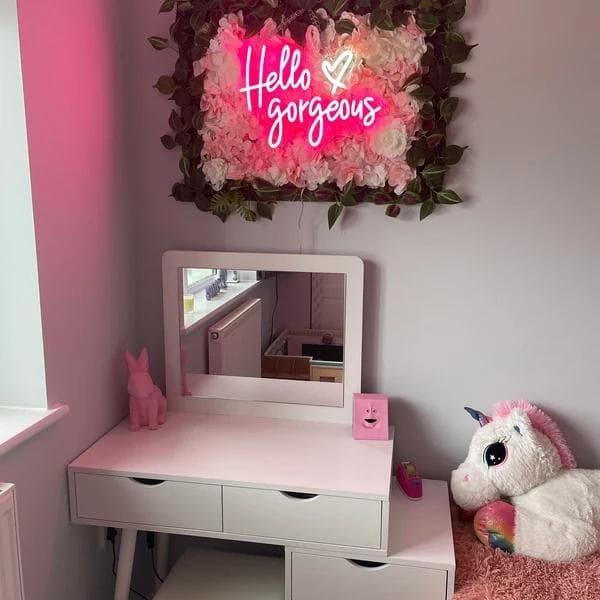
| Small accent: 15" to 20" (1.5 m flex) | 18 Watts | $0.91 / month | $2.18 / month | Bedroom nightlight, desk accent, nursery |
| Medium feature: 24" to 36" (3.5 m flex) | 35 Watts | $1.76 / month | $4.23 / month | Living room, wedding arch, photo booth |
| Large statement: 40" to 50" (5.0 m flex) | 50 Watts | $2.52 / month | $6.05 / month | Office lobby, cafe wall, salon station |
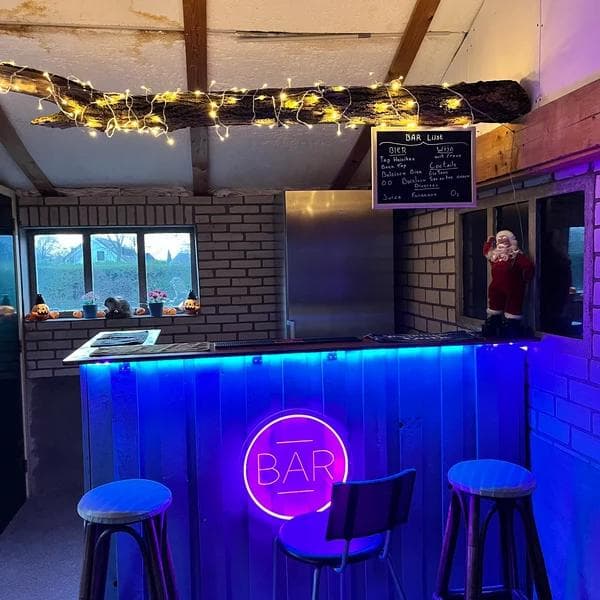
| Commercial logo: 60"+ (8.0 m flex) | 80 Watts | $4.03 / month | $9.68 / month | Retail storefront, bar facade, gym wall |
Even if you operate a medium 36-inch sign around the clock without ever powering it down, your total annual electricity expense is roughly $50.76 per year. Operating it 10 hours each evening drops that cost to roughly $21.12 per year—less than two dollars a month.
By comparison, a vintage glass neon sign of comparable dimensions draws 250 to 400 watts through an iron-core transformer, consuming roughly $30.00 to $48.00 per month in continuous electricity while emitting audible hum and substantial waste heat.
Safety comparison: modern LED neon vs traditional glass neon
The distinction between leaving an LED sign on overnight and leaving a vintage glass neon sign unattended is fundamental to electrical safety:
| Safety factor | Modern 12V LED neon | Traditional high-voltage glass neon |
|---|---|---|
| Operating voltage | 12V or 24V DC (Safety Extra-Low Voltage) | 2,000V to 15,000V AC (High voltage) |
| Surface operating temperature | 30°C to 38°C (86°F to 100°F) — warm to touch | 65°C to 110°C (150°F to 230°F) — burn hazard at electrodes |
| Physical tube material | Flexible, shatterproof silicone extrusion | Fragile, hollow leaded glass tubing |
| Gas containment | None (Solid-state semiconductor chips) | Pressurized noble gases (Neon, Argon, Mercury vapor) |
| Fire hazard rating | Class 2 power supply with auto-short cutoff | High-voltage arc hazard requiring GFI interlocks |
| Audible operational noise | Completely silent (0 dB) | Noticeable 50/60 Hz transformer hum and buzz |
Under international electrical safety standard IEC 60598-1, 12V DC power systems fall under Safety Extra-Low Voltage (SELV) regulations. Even if the silicone jacket is physically punctured, the electrical potential is too low to deliver a dangerous shock or ignite surrounding drywall, drapery, or wooden studs.

Leaving an LED neon sign on overnight in a bedroom or nursery
Many customers purchase custom name signs as ambient nightlights for children's bedrooms, nurseries, or master suites. While completely fire-safe, two practical considerations apply:
- Photobiology and sleep quality: Full-intensity LED neon emits significant photopic lux that can suppress melatonin production if left unmitigated. For overnight bedroom use, always select a warm color temperature (such as 2700K Warm White or Sunset Gold) rather than high-kelvin Cool White or Ice Blue.
- Dimming down for nightlight mode: Operating a sign at 10% to 20% brightness using an inline dimmer reduces lux output to a comfortable ambient glow, consumes less than 5 watts of electricity, and eliminates sleep disruption.
Does turning a neon sign on and off damage it?
A widespread myth from the incandescent lightbulb era suggests that turning lights on and off wears them out faster than leaving them on continuously. With modern solid-state LEDs, this is completely false:
- LED semiconductor chips: Unlike tungsten filaments that suffer thermal shock and evaporation during current surges, LEDs are solid-state diodes. Turning an LED on and off thousands of times causes zero physical degradation to the diode junction.
- The power adapter and capacitors: The component that does experience minor electrical strain during power-up is the AC/DC power adapter's electrolytic capacitor, which handles an initial inrush current. However, high-quality Mean Well or certified Class 2 drivers are engineered to withstand tens of thousands of power cycles without premature failure.
In short, turning your sign off when you leave the room or go to sleep will always preserve your sign's total operational lifespan compared to continuous running.
The critical bottleneck: the 80% power supply capacity rule
When an LED neon sign fails after one or two years of continuous 24/7 illumination, the culprit is almost never the LED tubing—it is almost always the 12V power supply brick.
An AC/DC power supply converts 110V/240V alternating wall current into regulated 12V direct current. In doing so, internal transformer coils and switching transistors generate ambient heat. If a sign requires 48 watts of power and is paired with a cheap 48-watt adapter running at 100% capacity around the clock, internal capacitor temperatures will exceed 85°C, leading to thermal breakdown within 12 to 18 months.
At The Glownique, our engineering workshop strictly applies the 80% maximum continuous load rule:
- A 20-watt accent sign is paired with a minimum 30-watt certified power supply.
- A 45-watt feature sign is paired with a minimum 60-watt certified power supply.
- An 80-watt commercial logo sign is paired with a minimum 100-watt to 120-watt power supply.
By ensuring the power driver never operates beyond 80% of its rated capacity, internal operating temperatures remain under 50°C, allowing the adapter to match the multi-year lifespan of the silicone neon tubing.

Four practical ways to extend your neon sign's lifespan
If you own a business that requires continuous daytime and evening illumination, or simply want your home sign to last a decade, implement these four workshop recommendations:
- Install an RF or touch dimmer: Running an LED sign at 70% to 80% brightness reduces power draw by nearly 30%, drops junction temperature by roughly 8°C, and extends the phosphor half-life from 5 years to over 8 years. Visually, the human eye perceives 80% brightness as virtually identical to 100% due to logarithmic pupil response.
- Use a $10 smart plug or digital timer: Rather than leaving your sign running while you sleep or when your shop is closed, plug it into a WiFi smart plug (compatible with Alexa, Google Home, or Apple HomeKit) and schedule it to turn on automatically at dusk and power down at midnight.
- Ensure driver ventilation: Never tuck the black power supply brick inside an airtight enclosed drawer, behind thick curtains, or beneath couch cushions. Mount or place the adapter in open air where convective airflow can dissipate heat naturally.
- Clean dust accumulation semi-annually: Wipe down the acrylic backboard and silicone tubing twice a year with a dry microfiber cloth. Heavy dust accumulation acts as an insulating blanket, trapping heat and degrading optical clarity over time.
Getting the most from your neon sign
Understanding electrical loads and thermal management helps you enjoy your custom sign with complete confidence. Whether you are illuminating a cozy home sanctuary or engineering an eye-catching commercial facade, modern 12V LED technology delivers brilliant illumination without the energy bills or fire anxieties of the past.
At The Glownique, every custom illuminated sign is built with commercial-grade optical silicone, mounted on precision laser-cut cast acrylic, and paired with an oversized, certified 12V power supply backed by our 5-year workshop warranty. Explore our collection of handcrafted custom LED neon signs to start designing your personalized sign, or consult our commercial specialists for high-impact custom logo neon signs for business.
Frequently asked questions
- Can I leave my neon sign on all night as a nightlight?
- Yes. Modern LED neon signs are powered by low-voltage 12V transformers, remain cool to the touch, and are completely safe to leave illuminated overnight in bedrooms, hallways, or nurseries. Adding an inline dimmer allows you to soften the light down to 10% brightness for ideal sleeping conditions.
- Do LED neon signs get hot enough to cause a fire?
- No. High-quality silicone LED neon flex dissipates heat evenly across its backboard and typically operates at a surface temperature of 30°C to 38°C (86°F to 100°F), which feels mildly warm like a smartphone battery. It will not scorch wallpaper, paint, foliage backdrops, or drywall.
- How much does it cost to leave a neon sign on 24/7 for a month?
- At the average US electricity rate of $0.168 per kWh, a standard 36-inch custom neon sign drawing 35 watts costs approximately $4.23 per month to run continuously 24 hours a day. Operating it 10 hours daily drops the cost to roughly $1.76 per month.
- What happens if you leave traditional glass neon on all the time?
- Traditional glass neon signs run on high-voltage transformers (3,000V to 15,000V) that generate substantial heat and draw 250 to 450 watts. Leaving vintage glass neon unattended for long periods increases the risk of transformer overheating, electrical hum, and gas electrode erosion. It is not recommended to run vintage glass neon unmonitored.
- Will turning my neon sign on and off frequently shorten its lifespan?
- No. Solid-state LEDs are unaffected by rapid on/off switching cycles because they do not have fragile mechanical filaments. You can safely power your sign on and off as often as you like without degrading the light output or diode health.
Sources
- Average Retail Price of Electricity to Ultimate Customers — US Energy Information Administration (EIA) (accessed 12 October 2026)
- IEC 60598-1: Luminaires - General requirements and tests — International Electrotechnical Commission (accessed 12 October 2026)
- Solid-State Lighting Technology Fact Sheet — US Department of Energy (EERE) (accessed 12 October 2026)
Turn the idea into a sign
Send us your logo, words or a rough sketch and we'll come back with a free digital mockup and a quote for your exact size — before anything is built.